
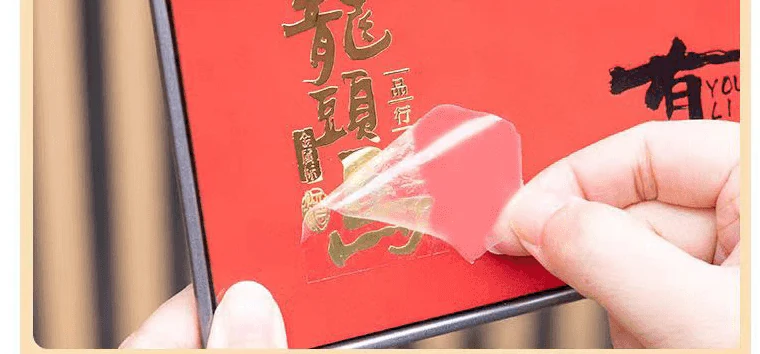
Identify the finished outer layer
Ask the packaging supplier whether the finished face is a laminated film, a varnish or another coating. Include the supplier’s reference, color and intended finish in your brief, even if the surface appears plain in a photo. Confirm whether the trial carton goes through the same production steps as the final carton. A paper swatch under a foil sample may be adequate for comparing color direction, but the label ultimately contacts the finish on the assembled box. If the cartons have a seasonal alternative finish or if two converters supply the same design, identify those separately. A single successful sample should not silently cover a different top layer.
Review gloss as part of the design
On a low-gloss carton, a shiny foil effect can have strong visual contrast. This makes alignment and edge quality easier to notice. Ask for a foil sample that includes the final letter shapes and any thin border or small secondary lettering. Review the label from a typical retail or unboxing angle as well as face-on. A design with thin gold letters can be attractive under one light and difficult to read as the box turns. Agree whether fine text should carry the same foil treatment as the main logo. A simpler border or a larger line of text can improve clarity without changing the brand mark.
Keep placement away from risky features
Open and close the assembled box and mark folds, flap gaps, seams and areas used to grip the lid. Place the decoration on a stable, reasonably flat region where it fits without bridging a hinge or stacking two surfaces under one graphic. If a border runs close to an edge, leave enough margin for variation in carton construction and positioning. A drawing can define the reference edge and target spacing. For a lid with a decorative inset, decide whether the inset edge or the outside perimeter controls the logo position. These references may be slightly different once the box is built.
Test the complete presentation
Prepare several cartons and record when the transfers are applied. Inspect the finished emblem, the surrounding surface and the label carrier removal. Note whether any mark comes from the transfer itself or from handling the carton surface during installation. Pack some decorated units in the intended packaging and handle others as an end customer would. If the inside of a sleeve or the divider sits directly against the foil, inspect that location on unpacking. Compare the finish with the approved reference under the same lighting. Make photographs of acceptable and unacceptable outcomes instead of using a single subjective word such as “premium.”
Decide how to approve changes
Small packaging changes can make a test obsolete. If the carton supplier proposes a different soft-touch coating, record it as a change on the project, then check representative production stock again. If the label changes from a large monogram to fine lettering, rerun the portion of the trial that checks edge integrity and legibility. Ask for a sign-off record that states the artwork revision, supplier finish, box geometry and sample date. That provides a way to compare later deliveries against what was approved. It also helps production teams understand exactly which part of the design can change without moving the approved foil position.
Example: one logo on two packaging lines
A fragrance business wants the same gold mark on its regular boxes and holiday gift sets. The regular cartons have a soft-touch laminate, while the gift sets use a coated rigid box with a different lid. The artwork is shared, but the sample request includes two separate surface references and two approved positions. On the gift set, moving the logo a few millimeters clears the finger recess; on the regular carton, the original location is retained. The buyer can now order a shared label version where it fits, while treating the packaging surfaces as distinct test conditions and documenting which proof belongs to each box.
What to send with the first sample request
A complete box and two unassembled swatches can answer different questions when available. The swatches are useful for placing more than one foil option on the material, while the finished box shows the lid geometry and handling points. Make sure any swatches really match the production finish. If asking for two sizes, identify both with separate artwork names and mark which sample should be fitted to which panel. This keeps the discussion focused on a real layout instead of treating a swatch result as approval for every face of the box. For brand approval, place the decorated box next to existing packaging that uses the same foil direction. Compare the whole group at normal viewing distance, then inspect the individual mark close up. If alignment is important, record whether you want the logo centred on the lid itself or optically centred within the visible design. That small distinction is easy to resolve on a mockup and awkward to correct after labels have been applied.
Questions to settle before ordering
Can a soft-touch box be specified from a color photograph?
The photograph helps with the layout, but the exact finish and finished cartons are more useful for evaluating adhesion and appearance.
Should you order full production after approving the foil color?
Check the size, placement and handling results as well.
What should the quote include?
Send artwork at final size, a carton photo, the stock or coating reference, quantity and any tolerance for position. Ask whether the supplier needs blank cartons or flat samples of the finished stock. If the project has several finishes, list each finish with its matching SKU and planned quantity.
Request a sample or quote
Send your artwork, surface details and planned quantity. Include any project requirements identified in this guide.
Discuss your project